Use trusted benchmarks to guide your org decisions.
Get BenchmarksFor many companies, the right organizational structure is one that supports faster decision-making, clearer accountability, and a stronger sense of direction. Meanwhile, a poorly designed structure, can create confusion and inefficiency. Among the most common models is the functional organizational structure, a design built around departments such as Finance, Marketing, and HR.
Evaluate your org structure – Search benchmarks now
This structure is popular because it brings order and consistency to complex organizations. In this guide, we define what a functional organizational structure is, explore its advantages and challenges, and highlight key benchmarks that help leaders assess organizational performance.
A functional organizational structure groups employees by their specific skills and responsibilities. Each department focuses on a particular area, such as Operations, Sales, or IT, and is led by a functional manager who reports up to executive leadership.
In this model, authority flows vertically within departments. Employees gain deep expertise, processes become standardized, and collaboration within each function is efficient. However, cross-functional coordination can be more challenging because teams operate within defined boundaries.
Put simply, a functional structure is efficient for organizations that value specialization and clear hierarchies over flexibility. Are you unsure what this looks like in practice? See the example of an organization with a functional structure below!
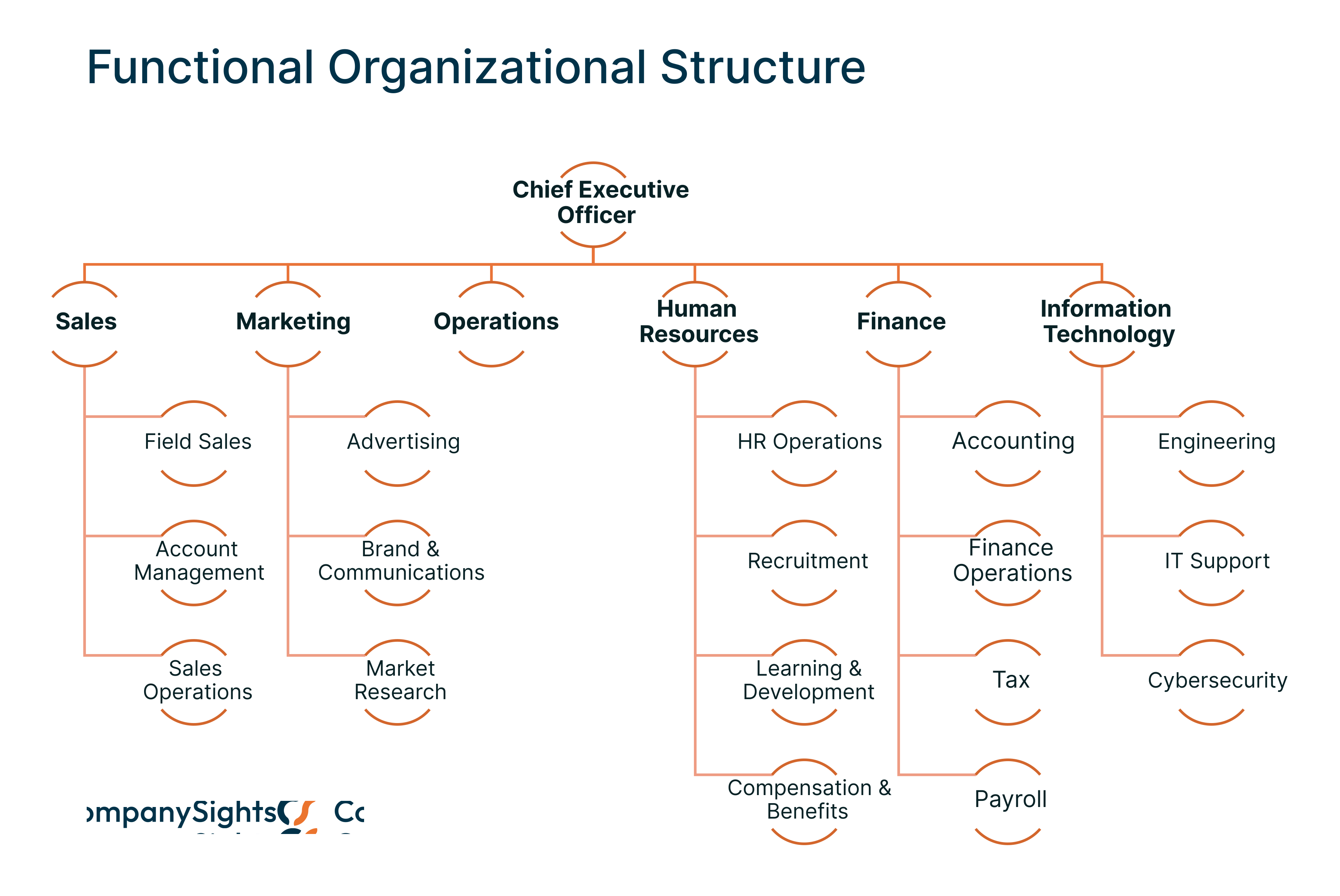
Imagine a mid-sized company organized around six departments: Sales, Marketing, Operations, HR, Finance, and IT (hint: see image above). Each department is led by a Director or Department Head who oversees specialized teams. For instance, the Marketing Director might manage content, advertising, and brand strategy teams, while the Finance Director supervises budgeting and reporting.
Information moves vertically within departments and horizontally between Directors when decisions require cross-department collaboration. While this setup supports efficiency, it can slow decision-making when multiple functions must coordinate.
In essence, the structure works best when roles are clearly defined and departmental goals align closely with overall business objectives.
Many organizations adopt a functional structure because it is an efficient way to grow. Key benefits include:
Functional structures thrive in stable environments where performance depends on optimizing operations rather than constantly reinventing processes. For example, manufacturing firms, financial institutions, and many large service organizations often favor this model because it helps maintain reliability and quality control.
While a functional structure is the preferred choice for many organizations, it is not without drawbacks. Its strengths can also become limitations as an organization scales. For example, some common challenges are:
As companies grow with a functional structure, cross-collaboration often drops off. Functional teams tend to focus on their own goals, rather than the success of the overall organization. To counter this, Department Heads must get on the front foot and promote a culture of cross-functional collaboration, as well as a focus on the organizations goals, not just their function objectives.
Approvals can take longer due to the growing number of management layers as an organization scales. The addition of each management layer is a question of control vs speed, with organizations that have slightly broader spans of control often achieving higher levels of efficiency.
Great ideas usually come from the collaboration of people with different perspectives. In the corporate world, this usually happens when cross-functional collaboration occurs. However, as businesses grow and become more complex there is less cross-functional collaboration (see the silo effect above), so ideas may struggle to gain traction.
To combat these common issues, organizations with functional structures must invest in communication tools, push for cross-functional projects, and set clear performance metrics that promote a collaborative and efficient culture.

Benchmarking provides valuable insight into how effectively a company’s structure supports its performance goals. Data-driven organizations often use benchmarks to identify risks and opportunities in each functional department. Here are four org metrics that you can benchmark:
Regular benchmarking allows leaders to detect inefficiencies, ensure fair workload distribution, and make data-informed adjustments to the structure.
Looking for functional benchmarks? Start your search
There’s no one structure that will always be the best fit. For businesses to stay on top of their performance, they need to periodically review and adjust their structure. Signs that your functional model may be holding you back include slow responses to market changes, duplicated work, and growing misalignment between teams.
Organizations typically reassess their structure when scaling rapidly, entering new markets, or launching new product lines. Further to this, benchmarking data can provide early warning signs, such as revealing when spans of control or headcount ratios fall outside industry norms.
As a general rule we suggest that businesses assess their structure every year while they are performing their annual strategy review or budgeting process. It goes without saying that a well-timed redesign can unlock agility without sacrificing the efficiency that functional structures provide.
A functional organizational structure for the right business brings clarity, efficiency, and deep expertise, but it also requires active management to prevent silos and sluggish communication. By combining clear departmental boundaries with benchmarking data, leaders can fine-tune their structure for both stability and performance.
The smartest organizations treat structure as a living system. They measure, compare, and adapt based on what the data shows, ensuring that their organizational design continues to serve their goals rather than constrain them. If you haven’t looked at your org structure in a while, now is the time to initiate a review.
Not exactly. A functional structure is hierarchical by nature, but it specifically organizes employees based on their job functions rather than products, markets, or regions.
If your organization values consistency, efficiency, and role clarity over rapid cross-functional collaboration, a functional model likely fits. Early-stage or innovation-driven companies might prefer more flexible structures.
A divisional structure groups employees around products, customers, or geographic markets, while a functional structure groups them by expertise (e.g. Sales, Finance, HR, etc.). Divisional structures are more adaptable but can duplicate resources.
Transitioning requires careful planning. A matrix introduces dual reporting lines, which can be confusing at first, but typically increases collaboration across functions in the medium to longer term.
Use external benchmarking data from industry databases or consulting firms. Focus on key metrics like managerial span of control, functional ratios, and decision-making speed.
Leverage data for the right structure – Search benchmarks

.svg)
Download a copy of our latest all industry report with data to benchmark the Finance, HR, IT and Marketing functions.
Insights are just around the corner.
.svg)
.svg)